|
The story of Daniel Kent Armstrong actually started out as somewhat a mystery to me. In my second interview with him
in 2000, my notes showed that Dan said he was born in Lakewood, Ohio - a suburb of Cleveland, on October 7th 1934.
Various brochures & literature also reveal this same information. However, it is a matter of record that his birth
certificate reveals he was born in Pittsburgh, PA. on that date. This came as quite a surprise and I couldn't help
but wonder what Dan had been thinking until some while later, while sifting through my notes looking for something else
entirely, that I came across the page about his birth date. In my quest for the other information
I was seeking, I almost missed it. And as I began to turn the page, a little footnote caught my eye, and I quickly
turned the page back. The note - taken from Dan's own words over the phone, solved the mystery. It verified his
birthplace and my error - that Dan was indeed born in Pittsburgh, PA. but grew up......
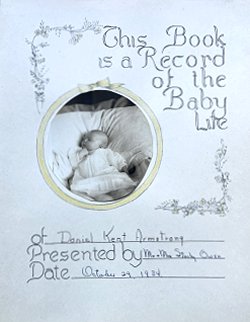
in Lakewood, Ohio. At left is Dan's baby picture. Photo is courtesy of Dan's grandson Aaron Armstrong.
|
He was born the son of Harry & Ruth Armstrong. Harry was an engineer responsible for heat treating equipment at the
Lee Wilson Engineering Co. of Rocky River, Ohio while Ruth, (maiden name Frost) was a registered nurse working at Grant
Hospital, then the Berea Community Hospital, and finally for Dr. William Bond, all of which were located in Berea, Ohio.
Given these work locations, it's seems plausible that the Armstrong family was originally from Pittsburgh but found
work in Ohio, and eventually relocated there.
While his fathers engineering skills would help serve Dan later on, his first interest was in electronics. New York's
legendary jazz guitar player, and Dan's former employee Eddie Diehl, continuously chuckeled when he told the story of Dan as a young
man who enjoyed using his ham radio set, stating "Dan used to take the inductor coil off an automobile, and somehow tie it
in and transmit with it, jamming radio stations and most every other type of transmission for miles around, possibly
as far as 100 miles. He got a kick out of this, and kept repeating it until the local authorities caught him by
triangulating the signal to his position and shutting him down." Eddie and I would stay in contact for some time after my interview
with him.
Dan's other area of interest at the time was, of course, music - and at the age of 11 he began playing guitar.
William Gamble writes in to say "Dan and I were neighbors in Lakewood and both graduates of Lakewood High School."
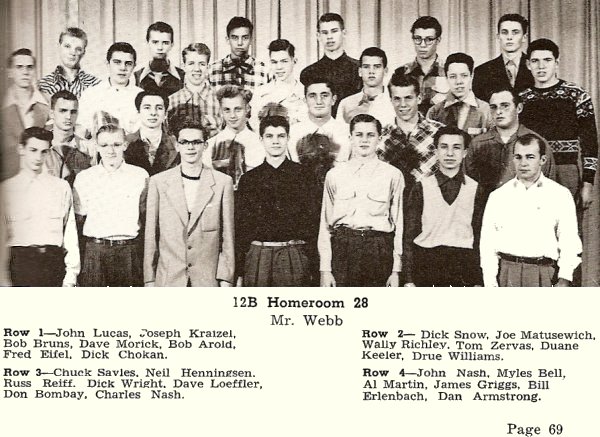 photo courtesy of Lakewood Alumni Foundation archives
Seen above is a photo of Dan Armstrong's homeroom class in his senior year at Lakewood High School - from the 1952
Cinema (the yearbook of Lakewood High School). Dan is at the far right in the back row.
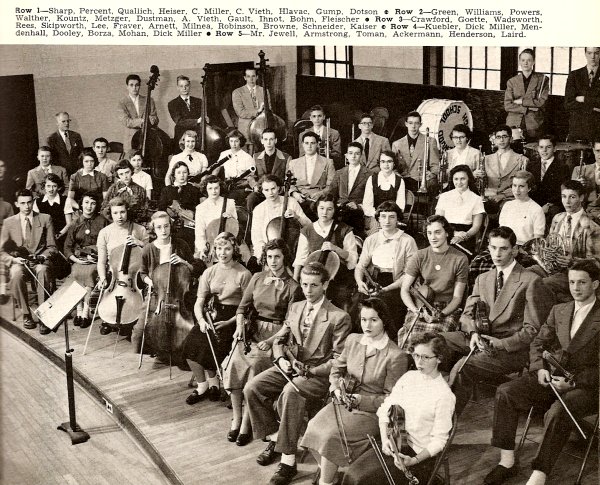 photo courtesy of Lakewood Alumni Foundation archives
Seen here Dan Armstrong is in the back row, first bass on the left. Being Dan was widely acclaimed as being such an
accomplished bass player makes this photo quite appropriate. "Dan absolutely loved fretless basses so when it came
time to produce his own line of clear guitars and basses - he said that he made sure some of the bass models were
going to be fretless." says Steve Kubica, friend and former employee of Dan. It's interesting to see how this
love of fretless basses most likely came about.
|
William Gamble continues, stating "I was in the class of '50 and I think he was in the class of '49."
(actually Dan was a senior in 1952) "We really only had what you would call a corridor acquaintance until after
high school when I began to study guitar.
Jim Hall was my teacher, and I
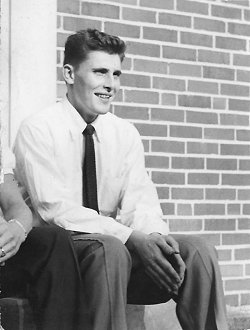
eventually came to learn that Danny was not only playing guitar already, but gigging around town." At left, a young Dan Armstrong,
probably still in high school. Photo courtesy of Aaron Armstrong.
|
Sometime after high school Dan met Donna Staley. Donna was a child actor originally from Los Angeles, CA who appeared in such movies as
“One Foot in Heaven”, “Angels with Dirty Faces”, “Sergeant York”, “Interns Can't Take Money”, “East of the River”, “King's Row”, and
“Spanky and Our Gang”. Later she moved to Cleveland, Ohio where she finished school and would eventually meet, and marry Dan. In time,
they welcomed a boy to the fold named Kent (Dan's middle name).
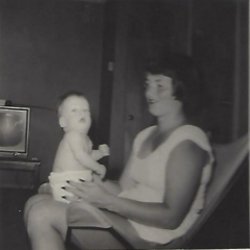
|
At left, Donna holds a young Kent Armstrong. Notice the old television in the background.
In time, Dan was gigging a lot more than just 'around town' for his talents on both guitar and bass were becoming widely known.
Kent Armstrong goes on to state "I really don't have too many memories of my father in my early years as he was away most of
the time travelling with bands on the road. When he was home, many times he had musician friends over jamming, and rehearsing.
That's about all I remember until later in life." Photo courtesy of Kent Armstrong.
|
|
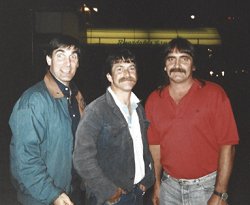
Eventually four more children joined the fold; Eric, Neil, (not that Neil) then a daughter Lory, and finally their last son Scott.
Seen here, from left to right, Kent, Eric & Neil Armstrong, probably sometime in the mid 1970's. Photo courtesy of Aaron Armstrong.
|
|
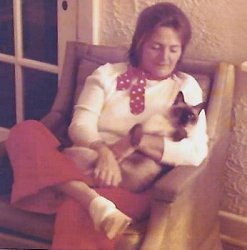
With Dan being away so much it made it difficult on Donna which eventually led to a divorce. Donna eventually moved to Florida in 1963 with her
five children - first to Delray Beach, then to West Palm Beach, where she was associated for many years with Jane Wendell Interiors of One Via
Mizner, Palm Beach, before starting her own business, Donna Armstrong Interiors, Inc. Seen at left, Donna with her cat in 1973. Photo courtesy
of Kent Armstrong.
|
Dan eventually moved to New York with dreams of becoming a master jazz guitar player. Work as a musician did not come immediately however, and
Dan would soon put his electronic skills to work doing custom rewiring of guitars as well as other set-up type repairs working for
Eddie Bell at Eddie Bell Guitar Headquarters which was located at 201 West
49th Street.
When not working on guitars Dan was playing them. He could usually be found jamming with friends and local musicians. It was not at all rare to
have famous musicians visit, and partake in these sessions, and it was here that Dan met Russell George, a jazz and session bassist who worked
with trumpeter Dizzy Gillespie as well as many others who were on the
professional circuit.
As a result, Dan's new circle of friends used their connections (which was usually just word of mouth), that would eventually land Dan in the
recording studios as a part time session player. With the gifted ability to play both lead or bass guitar, he became immediately in demand with
big name bands and it wasn't long before the music would take Dan on the road once again, and often he would rent, or borrow equipment from a
music shop called Caroll's. The owner, Caroll Bratman, soon discovered that his rental instruments were coming back in better shape than
when they went out, and eventually asked Dan to repair guitars for him. Dan agreed, telling me in 1999 that he was "soon taken to a
warehouse chock full of instruments - Gibsons, Fenders, Guilds, and many others. I had never seen so many instruments in one building before."
In 2011 I heard of the passing of Cynthia Armstrong - Dan's second wife who's memorial was online. Past visitors may remember that I had posted
the news of her passing on the front page of this site that year. In 2020 I had the good fortune to hear from the person who, unknown to
me - was the one that had actually posted Cynthia's memorial nine years earlier. It turns out that she is Cynthia Armstrong's niece, and she
apparently had at her fingertips some amazing photographs of Cynthia and Dan before, during and after their marriage in the early
1960's as well as others and has been both gracious and kind to share them with the world, and equally kind enough to take the time
to provide the text content for them, starting below.
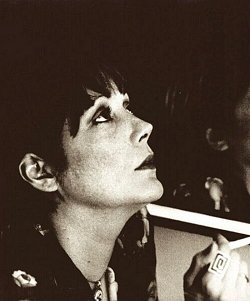
At some point in the early 60's Dan met Cynthia Brooks, a native of Columbus, Ohio. Cynthia was beautiful, stylish, vivacious,
intelligent, and independent. Her wicked sense of humor and penchant for playing with language appealed to Dan immediately. Perhaps in
keeping with their quirky sensibilities, Cynthia and Dan were married on February 29, 1964 – leap day.
Cynthia became a familiar face to those who haunted Dan’s storefront on LaGuardia place. Despite what observers believed was a true love
and affection between the two, their relationship became strained. Dan’s eye seemed to be wandering, and he and Cynthia fought often. By
1969 or so, Dan was introducing Carly Simon to people as his girlfriend, and the marriage was effectively over. The couple soon separated,
though the divorce was not finalized for some time afterwards.
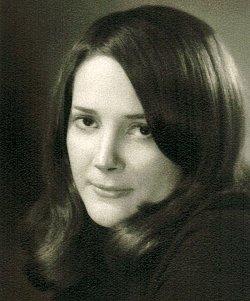
After Dan moved to the UK, the couple lost touch completely. Cynthia went on to enjoy a successful career as an advertising copywriter,
rising to the rank of Creative Director. She never remarried, and passed away in 2011 at the age of 74. The photos of her on this site,
and some details of her story, were provided by her loving niece.
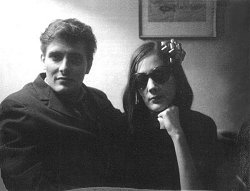
|
Danny and Cynthia on Christmas Eve, 1963, at the apartment of Cynthia’s sister and brother-in-law, 44 W. 55th St, New York City. Cynthia sports
a gift bow in her hair.
|
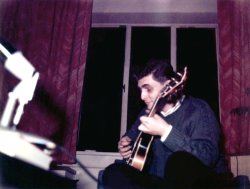
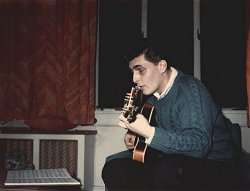
Danny plays what looks like a Gibson hollowbody guitar in the apartment of Cynthia’s sister and brother-in-law in January, 1964. Notice at
right Dan appears to be reading and playing from a songbook.
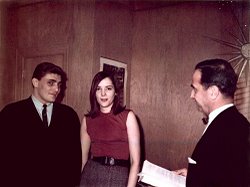
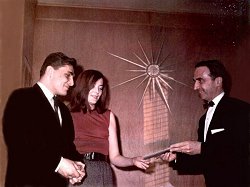
Cynthia and Danny saying their vows at the house of the Justice of the Peace at 2:30 PM on Saturday, Feb 29, 1964.
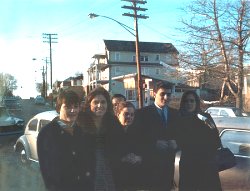
At left, this photo was taken shortly after the wedding outside the house of the Justice of the Peace. The location of the house is unknown but
may be in Queens or Brooklyn, NY. The wedding party, from left to right: Cynthia’s sister, Diane; Janet Babcock; her husband Dick Babcock;
Valerie (last name unknown); Dan Armstrong; and the newly married Mrs. Cynthia Armstrong. I like the second story cloths-line in the background.
Photo taken by Diane’s husband, Bud Hamilton.
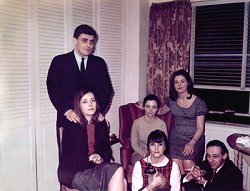
On the right, the wedding party at the apartment of Janet and Dick Babcock, 300 E. 40th St, New York City. Left to right: Danny standing over
Cynthia, Valerie (last name unknown) is sitting behind Diane, Cynthia’s sister, who is holding Janet’s cat, Zephyr; Janet sits on the arm of the
chair, and Dick sits on the floor with a martini in hand. The group would soon head out to celebrate at the Coral Lounge. Photo taken by
Cynthia’s brother-in-law, Bud Hamilton.
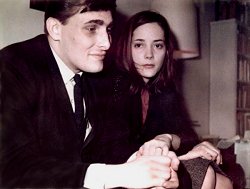
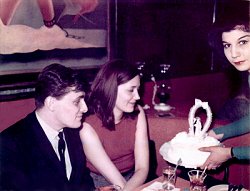
Newlyweds Cynthia and Danny at the party at the Babcocks’ apartment. Cynthia, looking cool, shows off her brand new wedding ring. On the right,
a waitress at the Coral Lounge, probably located on West 34th St in Manhattan, serves up a wedding cake to Cynthia and Danny, who are
comfortably ensconced on a banquette with some cocktails.
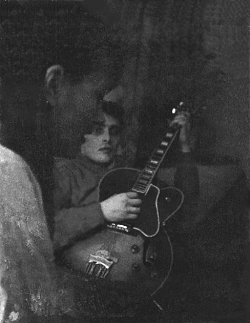
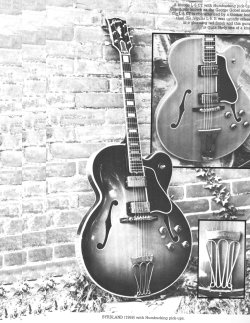
At left, Danny playing his guitar at the apartment of Cynthia’s sister and brother-in-law in 1964. Cynthia’s sister, Diane, looks on in the
foreground. On the right, Danny appears to be playing a late 50's or early 60's Gibson Byrdland guitar.
continue
menu
Names and images are TMand © Dan Armstrong / Ampeg. All rights reserved.
All other names and images are TMand © of their respective owners. All rights reserved.
|
| |