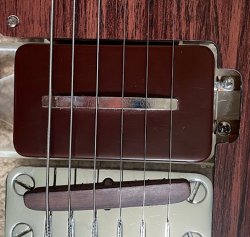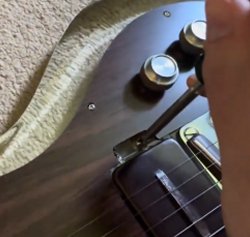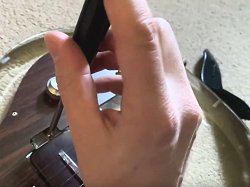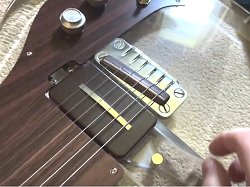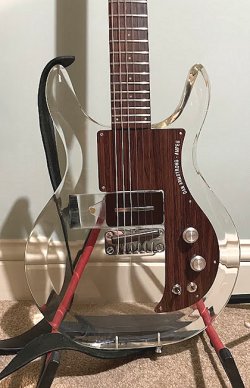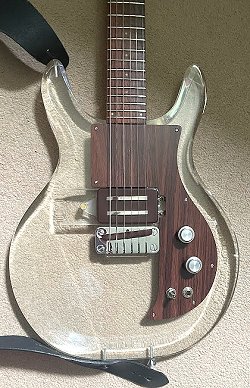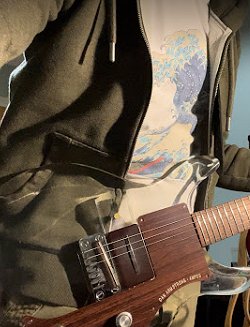
Seen at left, and with a pickup in place you can also see the pickup connection screws. At right and with the cutaway in the scratchplate Tom simply loosens the pickup connection
screws with a screwdriver with this pickguard.
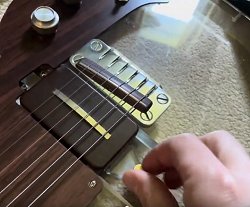
At left, and with the pickup connection screws loosened, Tom then loosens the channel thumbscrew and removes the triangular piece of acrylic that helps secure the pickup in place.
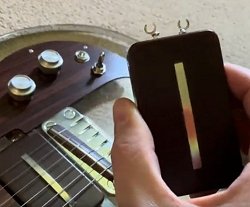
At right, and with the pickup he removed in hand, Tom slides the other pickup into the channel and under the connection screws.
At left, Tom tightens down the pickup connection screws while at right, he then replaces the triangular piece of acrylic and tightens down the thumbscrew. Pickup change complete.
Some might question the logic of two scratchplates but it must be remembered that this is not your average Dan Armstrong guitar which features the usual banana jacks to change out
pickups. On this guitar, with the stock scratchplate, to change out pickups one needs to de-tune the instrument, then remove all the scratchplate screws and lift the scratchplate
out of the way. Next you need to loosen the pickup connection screws, then loosen the thumbscrew in the channel to remove the triangular acrylic supporting piece and finally
remove the pickup. Then, you would insert a different pickup, tighten down the pickup connection screws, replace the acrylic supporting piece in the pickup channel, then put the
scratchplate back on and in place. Then put in the scratchplate screws and tighten them down. Once that's all done then you retune the guitar back up to pitch.
The above procedure is not exactly what many guitar players want to do on breaks between sets. By using this customized scratchplate instead, one can easily and quickly change out
pickups. Not surprisingly, Tom often uses this custom scratchplate as he likes the convenience of being able to quickly and easily change pickups. He's even considered cutting out
the notch on the Pickguard Planet's factory scratchplate just for the convenience of pickup changes.
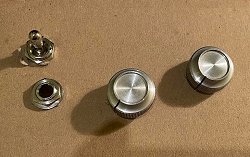
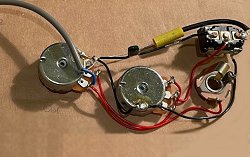
Above left and right, Tom states "While Angela and Tig were working on the guitar I acquired the necessary electronic parts for the control cavity. I got the pot values that I
needed from the hardware section of this site and bought D shaft type pots for the volume and tone controls on EBay. Being these pots had D shaped shafts meant that they would accept
the original Ampeg control knobs. The capacitors and output jack I had at home. For the selector switch I again accessed this site for the proper switch and I found it in the Hardware
section as well as in the Replacement Parts section of this site and I purchased it on EBay as well."
Tom added "I had the controls and components wired to be like Dan's later version, as per Mark’s recommendation regarding wiring it to
Ampeg's Product Bulletin #17 - which can be seen on the middle of the page that
is linked here. I had the harness all ready, I just needed to get the guitar back from Angela so I could install the electronics onto the pickguard - which I eventually did once I
picked it up."
The guitar is now back with Tom at his home. At left, with the stock pickguard (notice the lettering) - and at right, the customized pickguard - which has no lettering but has the
notched area. Both can seen better in the enlarged view.
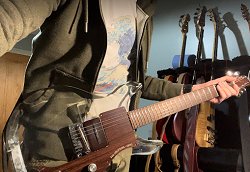
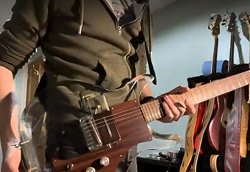
At left, a video of Tom playing the guitar with the stock pickguard (with lettering) from Pickguard Planet - while at right, another video of the same guitar but with the
'additional' notched pickguard that Angela made for Tom from extra pickguard material. In this video you can watch him change pickups.
So..... time for the big question. What's the story on this guitar? Unfortunately all we can really do is speculate. That said, there are a few hints to go on but that's about it.
One thing I believe we can all agree on is that it's a 1969 model.
At left, and seen in its entirety in the Brochures section here, is a 1969 brochure showing an early prototype Dan
Armstrong guitar that Ampeg had printed. In the enlarged view, you will notice many differences between this early model and the model that eventually shipped. However, take
special note of the fact that the pickup seen in the Ampeg brochure is quite narrow compared to the pickups that shipped and even thinner than the channel on Tom's guitar. Notice
too, that the pickup in the brochure looks to be permanently mounted but on the back of the flyer it says otherwise, stating that "In order to change pickups you loosen the
strings, pop out the pickup and put another one in and tune the guitar back up." Upon closer examination of the guitar in the flyer, notice the thin strip of scratchplate
between the rear of the pickup and the tailpiece. Notice too, that the tailpiece has only three screws that secure it to the acrylic body. The volume and tone knobs are different
as well, for they appear to be made of plastic and have what looks like the Ampeg 'A' on them. Lastly, notice that there are only two strap pegs on the acrylic body.
On the right, Tom's guitar was quite likely the next iteration in the development of Dan's clear guitar as it sports a sweeping pickup channel in the acrylic body and pickups that
are a bit wider and eventually encased in a brown resin to blend in with the faux-wood pickguard and headstock veneer. Dan himself told me that he wanted a series of pickups with
different sounds that could easily "snap in and out of the guitar". However, he never did elaborate on just how the pickups were going to snap in place before stating that
he decided that he wanted to "be able to change out the pickups without de-tuning the instrument." As you can probably guess, it was at this point that he came up with the
idea of the sweeping channel to be routed into the acrylic body that would allow pickups to be changed in and out while the instrument was still fully tuned. Original Ampeg factory
aluminum knobs have replaced the earlier ones seen in the factory brochure above. The origin and use of these aluminum knobs can be read about in the Hardware section of this site.
Furthermore, the tailpiece on Tom's guitar was now secured in place with four screws instead of three like that seen in the above brochure. Last, but not least, a third strap peg
was added and installed on the acrylic body as Dan said "With two strap pegs on the bottom the guitar won't tip over as easily when propped up against an amp while also giving
players the option as to which one works better when the guitar is strapped on."
I never gave much thought about that conversation until I began corresponding more with Tom as we prepared to do this section of the site. But given the narrow routing of the
sweeping channel on his guitar, which does not support later made interchangeable guitar pickups - I believe that the best evidence seems to suggest that the body of Tom's guitar
was caught in the middle - so to speak - and was made shortly after the pre-production model seen in this early Ampeg literature, but before the time when the pickups, and thus
the pickup channels... were widened even more. It also explains why the pickup connection area in his guitar is not like latter made guitars as the banana jack connection idea had
not yet been idealized. As such, I believe that Tom's guitar channel was routed and polished out for pickups wider than those in the Ampeg literature, but not as wide as the
pickups that would eventually ship in the future - and is likely one reason that it likely became an experimental model over time at Ampeg.
Other changes took place as well, for if you look at the literature again it's pretty obvious that the volume control pot on this model was sitting almost right on top of the
pickup connections. I believe this is when and why the guitars control cavity had to change, and the pots got moved further back. Other changes took place as well, as a switch was
added after Ampeg demanded that Dan put one on the guitar model. Also seen in the early brochure above, up by the 6th string the top corner of the scratchplate is rounded off in a
peculiar, or at least different fashion than what would be seen on the production models. Why the change on this corner of the scratchplate is unknown, aesthetics probably.
In the ever changing and disposable world that we live in, it's rare to come across a guitar that almost never was and Tom closes his story stating...
"It’s been an amazing journey of discovery, this guitar. While I have no hard evidence or confirmation that this is a prototype, it certainly has the signs of being one. I
have seen some of the early guitars with different routings to the traditional style. Keith Richards' guitars seem to have the rounded type control routing behind the pickup
(as seen in the video of him showing his Dan Armstrong guitar to Jimi Hendrix) in addition to guitars A132D and A217D seen in the Dan Armstrong Registry. Despite all this, I still
have plenty of questions about this guitar.
Could it have left the factory in bits as the regular pickups didn't fit? Was it a staff instrument? Or was it just a test bed to try new ideas, potentially being one of the early
prototypes Dan and Matt worked on? Was it lying around on the production floor when Dan parted ways with Ampeg and was eventually acquired by Lou Rose Music along with everything
else Dan Armstrong related - then eventually sold to George Thompson? Unless someone recognizes this instrument, or had a hand in it’s history I don’t think I will ever know as
they are all gone now. But I am really pleased to have a curious piece of Dan Armstrong history, and a mighty fine playing guitar at that!"
The Phoenix has risen - may it forever continue to fly.
menu
Names and images are TMand © Dan Armstrong / Ampeg. All rights reserved.
All other names and images are TMand © of their respective owners. All rights reserved.
|
| |