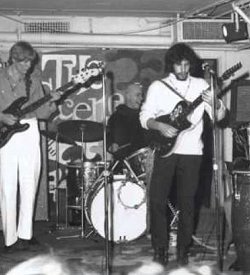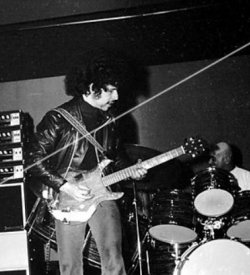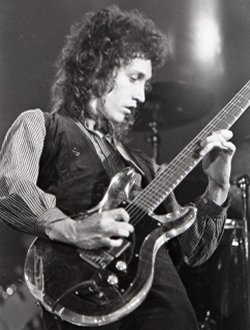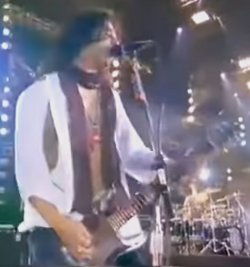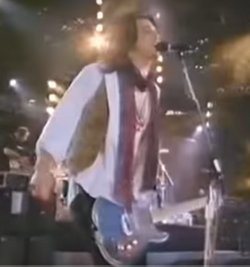
At left, Randy California and the band Spirit. Randy is playing a Danelectro guitar and knew of Dan Armstrong from his shop and how he stabilized Danelectro guitars to make them
play and sound better. He had Dan work on his guitar by having the volume knob moved up closer to the cutaway of the body which more easily allowed him to do his rather intense
volume changes easier. Apparently Dan also removed a switch that operated a type of tone switch and tone circuit that allegedly didn't do very much at all.
Being Randy was often in Dan's shop - he knew that Dan was working with Ampeg on a guitar made of acrylic and was pretty excited about the possibility of a
guitar that would feature interchangeable pickups.
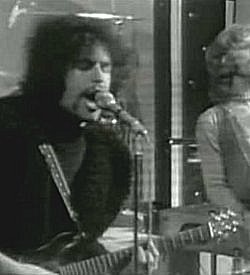
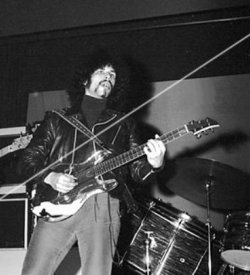
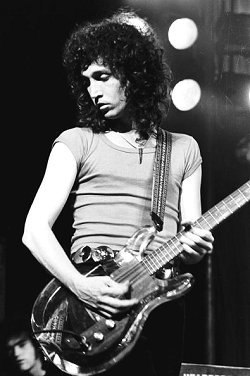
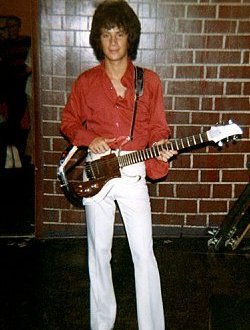
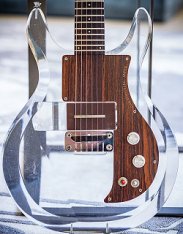
As seen at right, in late 1969, Randy had switched over to the aforementioned Dan Armstrong · Ampeg guitar. It wasn't long before Randy discovered that these
new clear guitars were heavily based on the Danelectro instruments.
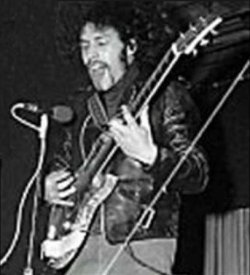
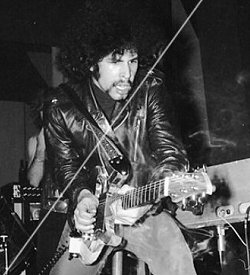
Above left and right, still playing a Dan Armstrong · Ampeg guitar is Randy California. Born Randy Craig Wolfe - at the age of 15 he
happened to meet a guitarist at Manny’s Music Store by the name of Jimi Hendrix, and before he knew it, he was gigging with Hendrix and his band Jimmy James
and the Blue Flames. Ironically, it was Hendrix who would come to name him Randy California, for there were now two Randy’s in the band and Randy Wolfe was
from California. So Randy California it was. It would be a name that would stick with him for the rest of his life.
At left and right, notice the unusual positioning, or routing of the guitar strap. Randy and Keith Richards were among the first two guitarists that would tour with this
radically new guitar. In most of these photos, notice the white tape on the lower portion of his clear guitar. At first, I thought he was just using alot of tape to secure
the guitar cord in place.

|
As it turns out, what Randy had taped to his Dan Armstrong guitar was a Boss Tone distortion unit. Using two silicon transistors, a pair of diodes, a few capacitors and resistors
and little else, it's reported that the units internal components changed often due to availability and market prices, As a result, the tonal sounds from one unit to another
could vary by a considerable amount.
A floor stomp box unit was available as well. It's repoted that Randy often changed control settings depending on the song and liked the controls to be at his fingertips. So
he plugged the unit into his guitar and taped it in place.
|
|
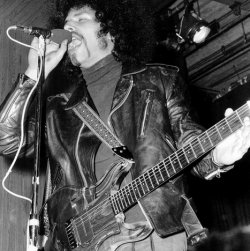
At Lyngby 'KB' Hallen, Copenhagen, Denmark in January 1970. In the enlarged view one can make out straight headed screws securing down the tailpiece, making
his instrument a very early model.
Also in the enlarged view is a modification of sorts. The rosewood saddle appears to have a fret across it which was not stock in 1969. Randy explains
“One thing that I'm quite proud of is the fact that Dan Armstrong later incorporated something I'd done to my Sears Silvertone - which I took to New
York to show him. I used to lay an unwound 20 gauge string over the wooden bridge of my guitar & when Dan saw it he started putting a fret across the wooden
bridge of his guitars.” The ball end of the string is clearly visible in the enlarged view - (pun intended).
|
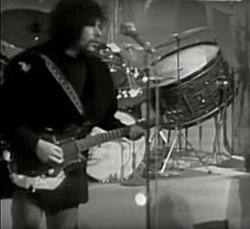
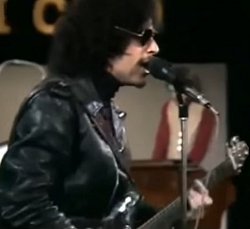
California and Spirit 1970 in various television appearances.
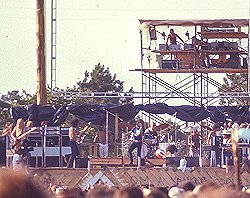
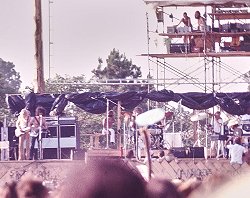
At left and right, photos of Randy California and his band Spirit - performing live at the Second Atlanta International Pop Festival
on Sunday July 5, 1970 in Byron, Georgia. Best seen in the enlarged views, he's second from left side of the stage playing his
Dan Armstrong · Ampeg guitar. Notice the Ampeg amp head he's also using - seen atop one of the Acoustic speaker cabinets.
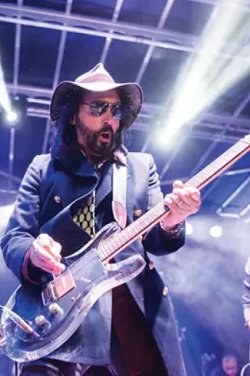
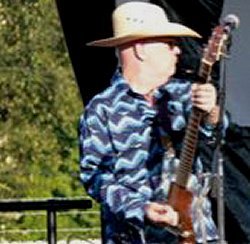
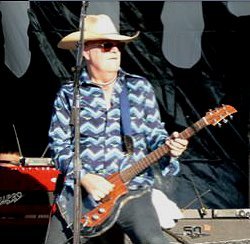
Mike Campbell, former guitarist of Tom Petty & the Heartbeakers as well as newly drafted guitarist of Fleetwood Mac recorded hit songs
with his Dan Armstrong · Ampeg guitar. At right, and years later Campbell has his own band called the Dirty Knobs
and is still accessing his Dan Armstrong guitar.
Mike is seen here with his Dan Armstrong plexi, but with a replacement black scratchplate. Seen better in the enlarged view, notice how
the back portion of the plate looks to have a lighter shade to it in addition to a somewhat different shape to it.
At right, Eric Carmen, went on to pursue a solo career after the Raspberries. Here he is seen with his Dan Armstrong clear guitar.
Dave Catching, guitarist of Eagles of Death Metal had been looking for a Dan Armstrong · Ampeg guitar for some time. According to
various sources, when he heard that Ampeg was reissuing them, he made a call and asked when he could get his hands on one to try. While playing a show in Seattle, WA
at The Showbox, Dave tried one out… and the guitar has been in his arsenal ever since.
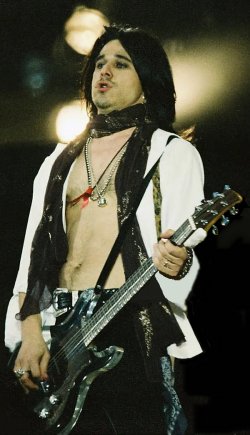
Above left and right, Gilby Clarke, rhythm guitarist of Guns N' Roses, who replaced Izzy Stradlin in 1991 often times played a Dan Armstrong · Ampeg
guitar on stage.
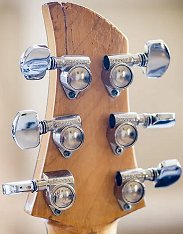
Upper left, at one concert, Gilby reportedly fell off the stage when playing his Dan Armstrong guitar. As a result, and as seen above, damage occurred to the headstock in the form of a
crack in the headstock. In the enlarged view you can actually see a gap in the maple. Ironically, the crack did not appear to go all the way through to the front. Equally ironic Gilby
wasn't hurt and amazingly the guitar was still in tune - so he said he just kept playing. Lastly, and as can be seen in the image directly below the headstock, it appears that a
replacement switch has been installed as the switch features a red bat handle which can also be seen better in the enlarged view.

|
While I couldn't locate a photo of Phil Collen playing a Dan Armstrong · Ampeg guitar, an interview exists online where he states
"When I started playing guitar, back in England, I used to see all of these classic American guitar players holding one of these see through, quasi-plastic
guitars and it looked really cool. I found out that they were playing one of these Dan Armstrong guitars. I wanted one for years until they stopped making
them and I’d forgotten all about them. Funny enough, in 2006 I had been wondering where I could get my hands on one and all of a sudden there was one, in a
backstage Ampeg shack outside the venue we were playing with Journey. Neal Schon was in there checking some stuff out with Scott, who would later work with me.
And there was this guitar. So I had to have one. This is a reissue and sounds amazing, considering it’s not even made out of wood. It made the odd appearance
on that tour. And you can hear it on Viv's (Vivian Campbell) rhythm guitar part, which was originally just a guide (Stones tuning) on Nine Lives."
This excerpt can be found online here.
|
return
menu
Names and images are TMand © Dan Armstrong / Ampeg. All rights reserved.
All other names and images are TMand © of their respective owners. All rights reserved.
|
| |