|
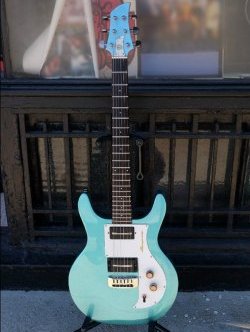
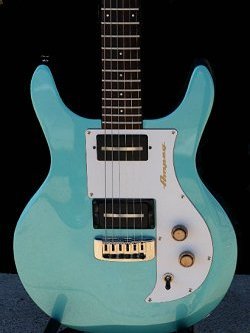
At left, a Dan Armstrong shaped guitar is seen in what Ampeg called a 'Seafoam Green' color. To me it looks to be more of a Teal color.
|
Unlike stock AMG1 instruments this guitar features single coil pickups styled somewhat like the Dan Armstrong acrylic models in that they employ full length
pole pieces. Beyond that they begin to differ as they are colored black and mounted differently. The neck pickup is mounted under the scratchplate while the
bridge pickup sports a black pickup ring. An adjustable bridge, white scratchplate with gold lettering, vintage volume & tone knobs and a black tipped 3-way tone switch top off the list. Unlike stock AMG1 models, or the Dan Armstrong acrylic models, the output jack is not mounted on the scratchplate,
but rather on the side of the instrument. Two strap buttons adorn the lower portion of the body with one such button on the upper horn in the usual
Dan Armstrong fashion.
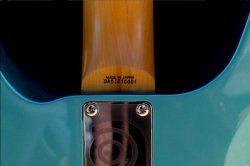
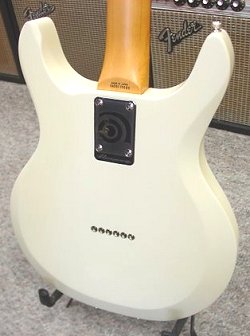
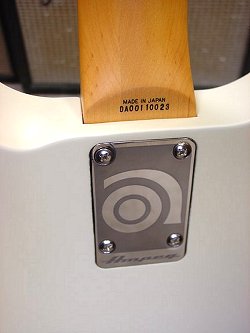
At upper right, and according to the serial number stamp, this guitar was made in Japan at Fujigen-Gakki and is very likely one of, if not thee - first guitar of 2001.
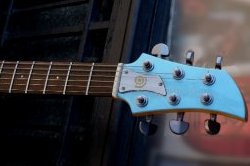
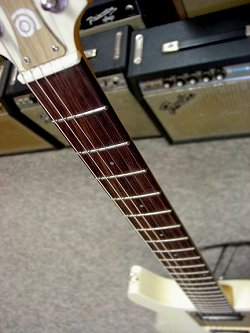
Notice the Ampeg emblem etched into the chrome neck plate. At lower right the maple neck features a rosewood fingerboard with 22 frets & dot position markers. The matching
finished headstock features Gotoh tuners and a white truss rod cover that matches the scratchplate and features the Ampeg a emblem.
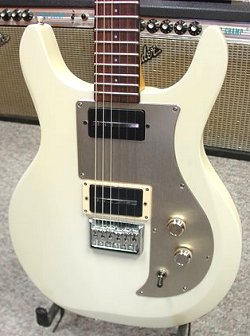
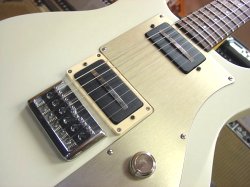
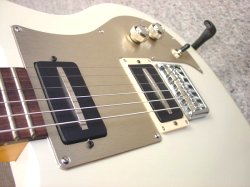
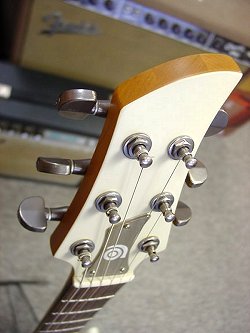
A White model almost identical to the Teal prototype above was also produced. It has the same features as the Teal model above but is adorned with
a brushed metal scratchplate and sports a different bridge/tailpiece. As seen upper left, the pickup ring surrounding the rear pickup is creme colored, while at right,
it appears that these particular instruments have a string through body design.
At upper left & right, and like its Teal counterpart, it is unknown what kind of wood the body is made of, but it's well known that
many of these early prototype AMG1 guitars were made using basswood. At upper right, at this angle, and at extreme magnification it
is apparent that the combination bridge & tailpiece unit is designed to accept strings from either the bottom of the unit
(for a a string-thru design) or from the back of the unit, for non string-thru instruments. It can be
seen here.
The necks however, are a little bit easier to decipher due to the fact that they have a natural finish. At upper left you can easily spot the seam of
the laminated maple used to make up the neck just to the left of the instruments serial number. At right, and quite easily spotted,
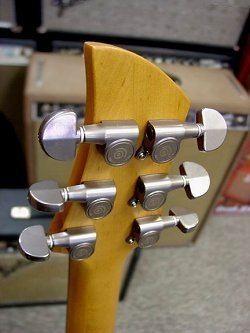
you can make out the three pieces that makes up the headstock.
At left, and like the Teal model, the maple neck is topped off with a rosewood fingerboard with small dot position markers. The truss rod cover
features the same brushed metal that matches the scratch plate, and has the Ampeg logo on it. On the right, the headstock features tuners
(probably Gotoh) that are also adorned with the Ampeg emblem on the backside.
According to Tom Kruszka "The white one is a prototype that never went into production. It was manufactured in 2000 but I have no other
info other than it was a Fujigen product as were all of the AMG1 series."
next
menu
Names and images are TMand © Dan Armstrong / Ampeg. All rights reserved.
All other names and images are TMand © of their respective owners. All rights reserved.
|
| |