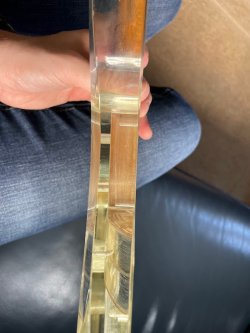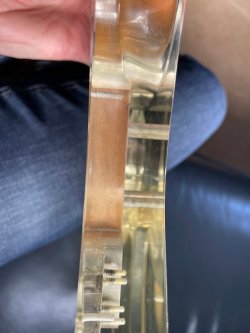
A Dan Armstrong · Ampeg guitar that will forever be one of a kind. And like the legendary bird of Greek mythology that rose from the
flames of its former ashes - this guitar has risen once again. It is for this very reason that I decided to name it 'The Phoenix'.
It almost wasn't so. The instrument was the property of Mr. George Thompson
of Tarzana, California. A gifted guitarist, and sound engineer who had passed away in late February of 2023. With his estate up for sale, one item was a parts guitar that had
apparently been sitting idly by in his closet for who knows how long. Perhaps decades.
This parts guitar eventually made it's way to the online auction site EBay - where at end of August, 2024 it was acquired by Mr. Tom Burdett of
England. After several email's to me, asking questions and requesting measurements I became rather intrigued and it wasn't long before I had asked Tom
for permission to use his photos that he had already taken - along with future photos that I hoped he would take - as I knew that this instrument was
more than worthy of a chapter all its own on this site. As we continued our correspondence I eventually asked him to write a journal as he began to
restore this rare bird to its 'one-ness' - maybe for the first time ever.
Tom agreed and relates his story, starting at the very beginning stating "Back in the early 2000’s I was in secondary school and was just starting to learn to play the guitar.
The first proper concert I went to was the Foo Fighters at Wembley Arena on their One By One tour back in 2002. During this time Dave Grohl was playing his Dan Armstrong guitars
exclusively for the shows.
Needless to say, the image of those futuristic see-through guitars was forever ingrained on my psyche and will forever be associated with rock and roll. As my musical tastes
developed, I began listening to older groups, including Aerosmith and the Rolling Stones. I kept seeing these see-through guitars in the hands of the players I liked and I knew
that one day I would have to get myself one."
"Late one night in the summer of 2024 I was doing the dangerous task of surfing EBay just before bed. I had searched periodically for Dan Armstrong guitars but I never found
one to match my budget. On this particular night I stumbled across a listing on EBay - though in America - for an acrylic body and neck of a very old Dan Armstrong acrylic guitar
which featured one pickup as well as a broken/partial scratchplate that had no electronics mounted onto it at all. The listing stated that the instrument was an early 1969 model,
which I then verified from the smooth Formica headstock and partial scratch plate. The neck featured early Schaller tuners and fortunately the body still had the main bridge plate
attached, and secured in place with the early straight slotted screws anchoring it to the acrylic body. Unfortunately, there was no rosewood, nor any other type of saddle found.
After some Googling to verify all this, I came across this web site as well as the Dan Armstrong Registry. Using these web sites I was able to ascertain that the
seller seemed to be correct in dating this instrument to a 1969 model. I could also tell the guitar needed some repair work beyond replacing the missing
bridge saddle, electronics and scratch plate. A previous owner had somehow managed to chew up the area under the truss rod cover and 'break-on-
through to the other side' i.e. - the back of the neck, creating a hole that was visible behind the headstock. In addition, the back of the neck had,
for whatever reason, been sanded through the lacquer and into the bare wood. I was still confident that the guitar could be repaired however, and that the missing parts
replaced with modern day equivalents.
I put in a bit of a 'cheeky' offer, half expecting to have to wrestle a higher bid later on, but I had a price in mind that I was willing to go up to
so I went to bed and thought nothing more of it. I awoke the next morning only to find out that the seller had accepted my offer and that I had
already been charged for it. Oh my, I thought."
|
|
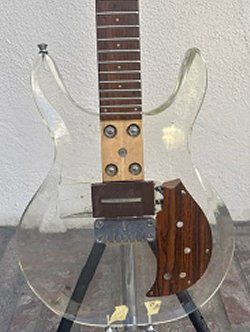
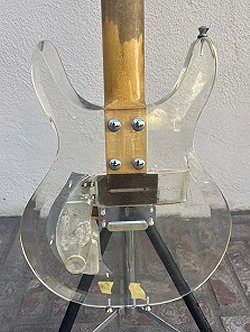
At left is the Dan Armstrong instrument that Tom had acquired. I immediately noticed the broken scratchplate and wondered where the other half
of the plate was - thinking 'A li'l JB Weld to the rescue!'. Alas, it was not to be. At right, and in addition to the sanded down neck I
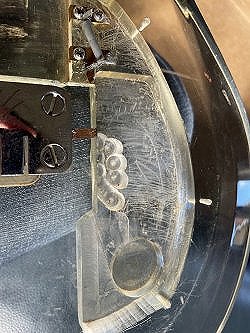
noticed some unusual routings in the acrylic of the control cavity.
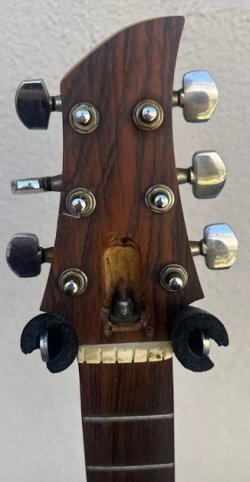
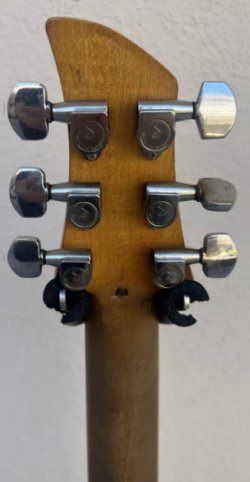
At left, and according to Tom, "The headstock had retained the faux-wood veneer but the string slots in the Ivory nut were all slanted to the
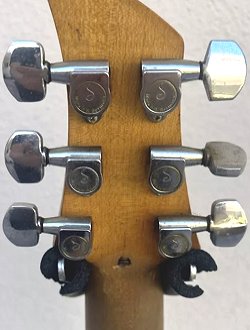
right - towards the lighter gauge strings for whatever reason. At right, the headstock like all early models have Schaller tuners on it which I learned
were Dan's favorite."
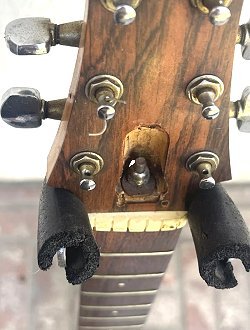
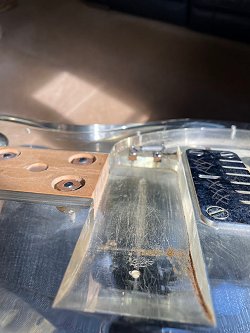
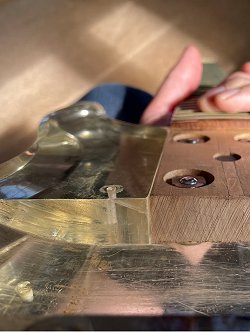
At left and right, and as Tom had mentioned " Disaster struck at one point as either the sanding of the neck &/or perhaps a wrench on
the truss rod nut perforated a small hole through the maple neck just under the truss rod nut."
Seen at left and right, Tom points out " There is no serial number on either side of the neck tongue."
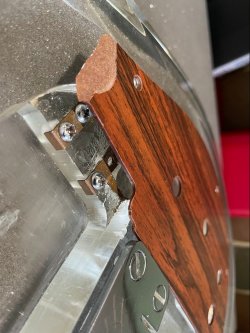
Tom continues, stating "After looking at the routing of the control cavity, and in particular where the pickup would connect, I noticed that the
acrylic body had a raised section with screw terminals for the pickups to connect to the wiring of the controls. Comparing images on this site and
the Dan Armstrong Registry - I realized that the routing for the control cavity, and moreso for the pickup connections were nothing like the eventual
production guitar models that utilized banana jacks. Instead, the pickup connection closely matched those of the original bass models."
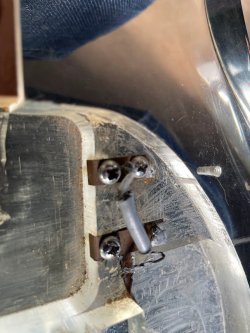
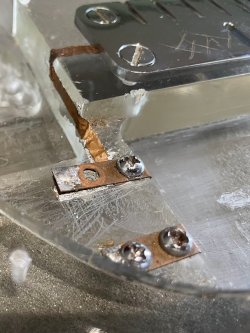
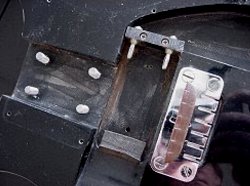
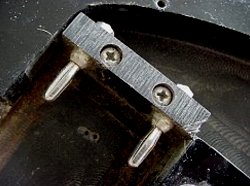
On the left and right, and seen better in the enlaged view, a closer look at the screws and strips of copper that make the connection from the pickup
to the control cavity can be seen. Notice too, the lack of any acrylic wall for male banana jacks to be mounted onto. Like Tom stated..."It's as though using banana
type jacks hadn't even been considered for this instrument."
At left, notice how the flat copper strip travels from one of the screws and tucks in under the tailpiece. I'd say it's pretty clear (pun intended)
as to which screw the ground wire from the control cavity gets attached to. At right, notice the unusual, small and shallow holes that were made in
the acrylic that Tom mentioned earlier. The origin of these holes is unknown.
Tom continues, stating.... "Around this time, I started emailing Mark to show him my find and to get his opinion on what it might be. Was the guitar real? Was it a copy? I
took many photos and measurements of the parts and asked him to compare them to his originals. Mark confirmed that the parts were original and indicated that it is an early 1969
version, even highlighting minor details, like the routed channel for the ball end of the strings being the earlier, narrow version. He also pointed out the straight slotted screws
that secured the tailpiece to the acrylic body was consistent with an early 69 model. He then pointed out that the connections for the pickups to the controls are not like that on
normal production guitars as there were no male type banana jacks."
|
|
Tom continues, stating "Mark also pointed out that the curved route of the control cavity on my guitar is virtually identical to the cavities of
the black butyrate experimental guitar models seen above as well as in the Acrylic Guitar
section of this site. There was no easy way to attach the banana jacks to the control cavity on this guitar without a considerable amount of routing
in order to put in a wall like what is seen above in the black model, and then attach male banana jacks to that wall so that the pickups could easily
slid on and out.
Even then, I would need to modify the control routing of the body - for if we would install such a bracket, or wall, with the banana jacks, the
pickups would sit further up on the bass end of the body and the pickups magnet would not even get underneath the high E string. The only way to get
the pickups magnet underneath all of the strings would be to extend the curve of the control routing further away from the high E string. But by then
the original style scratchplate wouldn't cover it.
Also, in order to use the stock guitar pickups I would need even more routing done in order to widen the entire sliding pickup channel to
accommodate the 'stock' interchangeable pickups - as the pickup channel on this model is too narrow. Above all else though, I wanted to preserve
history, and keep the body in as original condition as I could, and make use of the existing screw holes in the control routed section where the
pickups were screwed in. So I instead opted to ask Kent Armstrong to make me guitar pickups - but make them using the bass guitar pickup enclosures - for
unlike the interchangeable guitar pickups, the bass pickups fit within the confines of the pickup channel on my guitar."
next
menu
Names and images are TMand © Dan Armstrong / Ampeg. All rights reserved.
All other names and images are TMand © of their respective owners. All rights reserved.
|
| |